CNS 2011 in Stockholm, Sweden

Program Book Workshops Program
Abstract Publications Travel Awards
Student poster award winners Photos
CNS 2010 in San Antonio, Texas

Program Book Abstract Publications
Workshops Photos
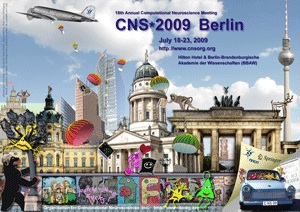
CNS 2009 in Berlin, Germany
Program Book
Abstract Publications
Tutorials
Workshops
Neuroinformatics Symposium
Travel Awards
CNS 2008 in Portland, Oregon

Program Book
Abstract Publications
Workshops
Student Poster Awards
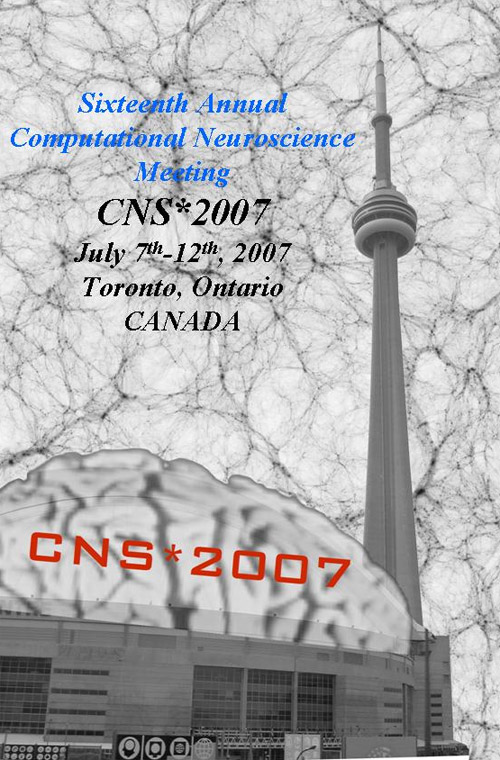
CNS 2007 in Toronto, Canada

Program Book
Abstract Publications
Workshops
CNS 2006 in Edinburg, UK
Program Book
CNS 2005 in Madison, Wisconsin
Program Book
CNS 2004 in Baltimore, Maryland
Program Book
CNS 2003 in Alicante, Spain
CNS 2002 in Chicago, Illinois
CNS 2001 in San Francisco, California
CNS 2000 in Bruges, Belgium
CNS 1999 in Pittsburgh, Pennsylvania
CNS 1998 in Santa Barbara, California
CNS 1997 in Big Sky, Montana
CNS 1996 in Cambridge, Massachusetts
CNS 1995 in Monterey, California
CNS 1994 in Monterey, California
CNS 1993 in Washington, DC
CNS 1992 in San Francisco, California
|
The annual Computational Neuroscience Meeting (CNS) began in 1990 as a small workshop at the Clark Kerr Campus in Berkeley, California. The workshop was called Analysis and Modeling of Neural Systems, and was a small, local event that included 21 invited talks and 36 posters. The goal of the workshop was to explore the boundary between neuroscience and computation, which by the late 1980s was just starting to become an identifiable field in its own right. Riding on the success of the seminal papers by Hopfield (1982) and Hopfield and Tank (1986), physicists had made "Neural Networks" fashionable, and soon the quantitative methods used in these abstract model networks started permeating the methods and ideas of experimental neuroscientists. As biologists and computational scientists started talking to each other and collaborating, new generations of students became fluent in both experimental and quantitative techniques. The CNS meeting lives at this interface, where experimental neuroscience meets theoretical, statistical and computer-simulation analyses, with the hope of turning large collections of experimental results into a principled understanding of nervous systems.

The first "CNS Meeting" was organized by Jim Bower and John Miller in San Francisco in 1992. In the early 1990s, the CNS meeting received about 100 submissions per year. By 1997 the number was over 200, and in 2009 it included more than 650 submissions.
Still, the aim is to maintain the collegial spirit of the early meetings, which revolves around lively discussions after the talks, during late-night poster presentations, while enjoying the traditional banquet, or even during excursions to local touristic sites (yes, even then). In addition to this fun and casual environment, CNS has two prominent features. First, since its early editions, CNS has been a forum for young scientists -- graduate students, postdocs and junior faculty -- who present their work and have the opportunity to talk with more senior leaders in the field. In fact, the proportion of faculty, postdoc and student attendees has remained quite steady over the years, at about one third each.

Second, it has become a truly international meeting. Reflecting this, in the year 2000 CNS was held in Europe for the first time (in Brugge, Belgium), and since then European sites were chosen in 2003 (Alicante, Spain), 2006 (Edinburgh, Scotland), 2009 (Berlin, Germany) and 2011 (Stockholm, Sweden).

Those of us involved in the OCNS, board members, local organizers, members of the program committee, and many of our sponsors, have been to many CNS meetings throughout the years and want to keep the tradition going -- not for tradition's sake but because we have all been energized, challenged and motivated by these meetings, and believe that new generations will similarly benefit, as both experimental and computational techniques evolve into more sophisticated and powerful tools. Our goal is to organize a high-quality meeting that is both informative and fun.

|